Een Nederlandse Inleiding
Onderstaande (Engelstalige) post gaat over chemofobie — het diepgewortelde wantrouwen jegens synthetische moleculen — en hoe deze angst via alledaagse dingen wordt verankerd in ons collectief geheugen: boetseerklei en moedermelk.
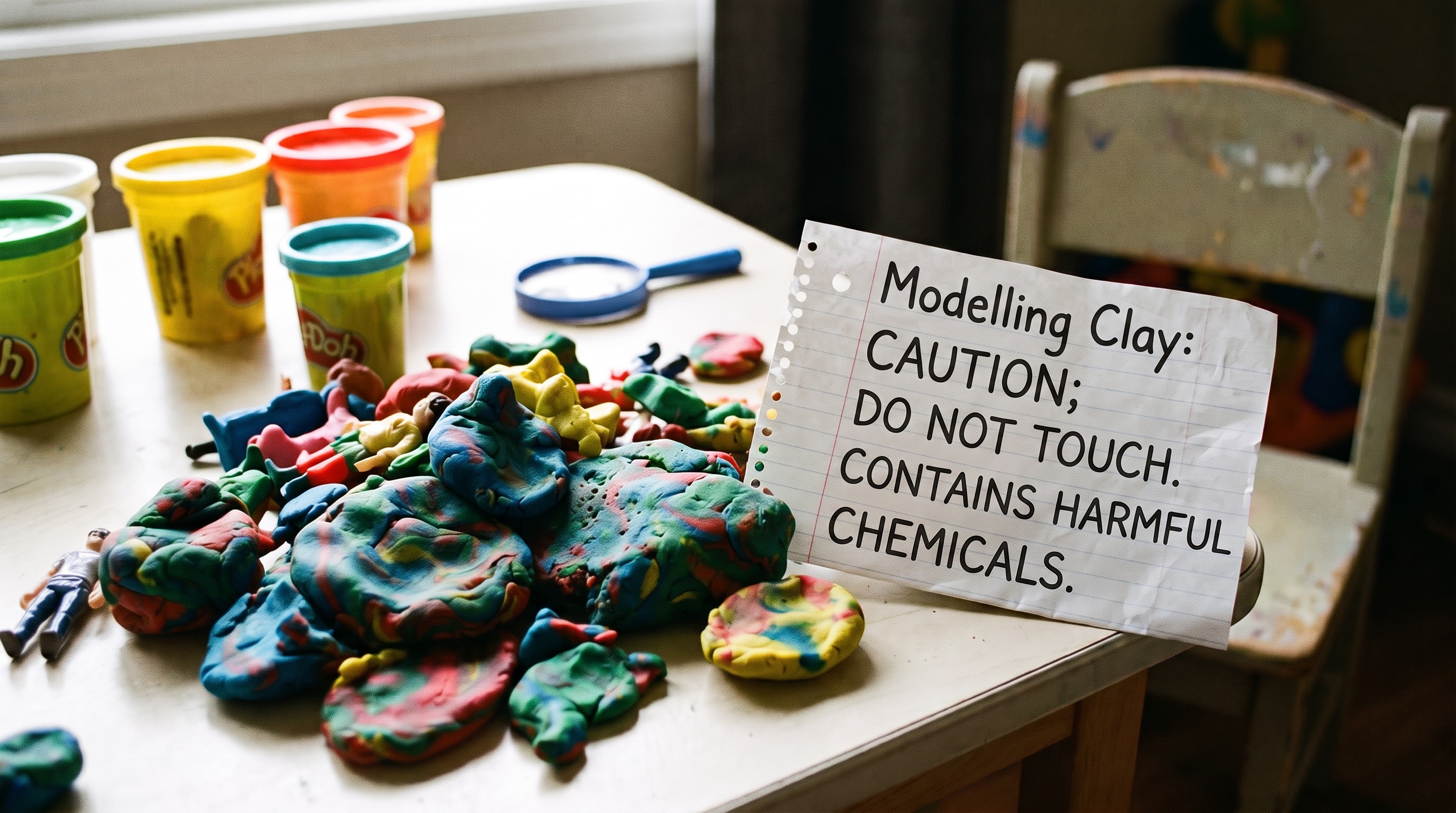
Eerst de klei. Nationale autoriteiten in de EU willen bepaalde boetseerklei van de markt omdat er te veel conserveermiddelen in zitten: methylisothiazolinon (MI) en chloormethylisothiazolinon (CMI), bekende huid sensibilisatoren boven een bepaalde drempelwaarde.
Maar die conserveermiddelen zitten er niet voor niets in: klei op basis van zetmeel en water beschimmelt razendsnel, en schimmels produceren gifstoffen en allergenen die niet ongevaarlijk zijn.
Dat de wettelijke norm (Richtlijn (EU) 2015/2117) is overschreden staat niet ter discussie; zulke normen reguleren echter vooral de markt en zijn geen maat voor daadwerkelijk risico.
Risicobeoordeling zelf drijft op keuzes: veiligheidsfactoren (100, 300 …) op toxicologische eindpunten, blootstellingsschattingen die stelselmatig naar worst-case-scenario’s neigen. Alsof al het conserveermiddel in de klei aan de handen volledig met de huid in contact staat.
Wie de veiligheidsfactor maar hoog genoeg kiest, verbiedt uiteindelijk álles en laat kinderen met beschimmelde klei spelen. Of je verbiedt alle speelgoedklei tout court.
Dan de moedermelk.
Het RIVM (briefrapport 2026-0028) meldt dat 18% van de onderzochte moedermelk de ‘risicogrens’ voor PFAS overschrijdt. Die grens (133 picogram per ml — een picogram is 0,000000000001 gram) is gemodelleerd op de EFSA-TWI van 4,4 ng/kg lichaamsgewicht per week.
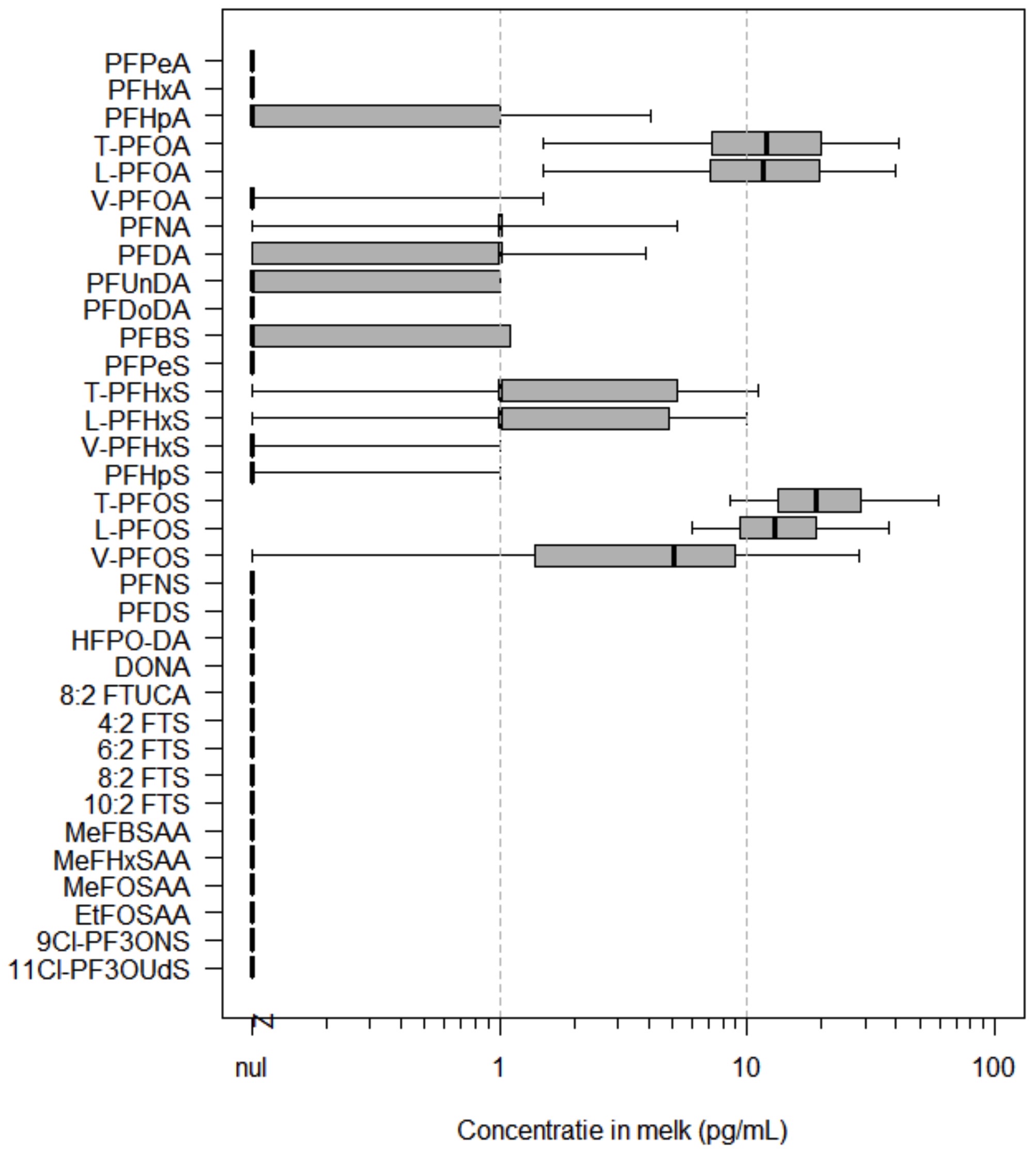
Van de 29 gezochte PFAS werden er 21 zelden of nooit aangetroffen.
Eén studie (Abraham et al. 2020), waarvan de onderliggende data nooit zijn vrijgegeven en waarvan onze kritiek (The PFAS Conundrum) door het RIVM niet wordt besproken, speelt een belangrijke rol in deze norm.
Conclusie: de kosten van deze aanpak zijn niet alleen financieel. Integendeel.
Producten worden vernietigd op grond van marktnormen, moeders worden bang gemaakt voor borstvoeding en het publiek leert gevaar te zien in speelgoed en melk.
De dosis maakt het vergif, natuurlijk óf synthetisch. Risicobeoordeling vergt keuzes die open gemaakt en verdedigd moeten worden, geen verstopte worst-case-aannames en verborgen data.
Niet PFAS, maar angst is de echte forever chemical.
Introduction
A bit of a longer English (and-of-summer-)post than usual. It’s about chemistry, of course. (And who is gonna read about thàt?) Molecules, those universal building blocks of our empirical reality, are distrusted greatly, especially of the man-made, synthetic, kind.
The ’everyday stuff’ we will look at below is a children’s toy - modelling clay - and breastmilk. The chemicals of choice are PFAS as detected in the latter and preservatives as present in the former.
For me, breastmilk was not on the menu as a baby (so I was told by my mum).
But, almost every child, including little me, played with modelling clay. However, national authorities within the EU want some of this clay off the market, ASAP.
Why? Too much biocides, preservatives that is!
The preservatives in question - methylisothiazolinone (MI) and chloromethylisothiazolinone (CMI) (cool names, not?) - are well-recognised skin sensitisers when exposed above a certain level (the so-called NESIL - the no-expected-sensitisation-induction-level).
That means that people repeatedly exposed to these preservatives without initial allergic reactions will be sensitised so that subsequent exposure could result in allergic contact dermatitis.
Biocides in modelling clay? Is nothing ‘safe’ nowadays from those pesky man-made molecules?
Well, things are not as straightforward as they seem. Let’s have a look at the chemistry that surrounds us and is found within us as well, PFAS included.
As we will see, the world is not black versus white, synthetic versus natural, that is bad versus good. Indeed, this bad-good dichotomy is nothing other than polarising cluelessness.
Preserving modelling clay through chemistry
First, why are there preservatives in a toy for children in the first place? On the face of it, that seems asking for trouble. But, the clay in question is made from mostly starch, some water and a dash of additives (like colourants). And biocides.
Adding preservatives has a simple reason: starch mixed with water will mould very quickly.
Fungi are ubiquitous and far from innocent. Fungi are well-known producers of diverse toxins with all sorts of deleterious health effects, such as cancer. Also, fungal allergies and sensitisation to fungal allergens are risks not to be sniffed at.
(Again, dear readers: the dose makes the poison, whether that dose is from a natural of man-made source!)
So, adding preservatives to modelling clay is a common procedure as to guarantee the safety of the toy. The conflict that arose is that, legally, too much of MI/MCI was added to the clay in question, that is beyond the toy standard as found in Commission Directive (EU) 2015/2117:
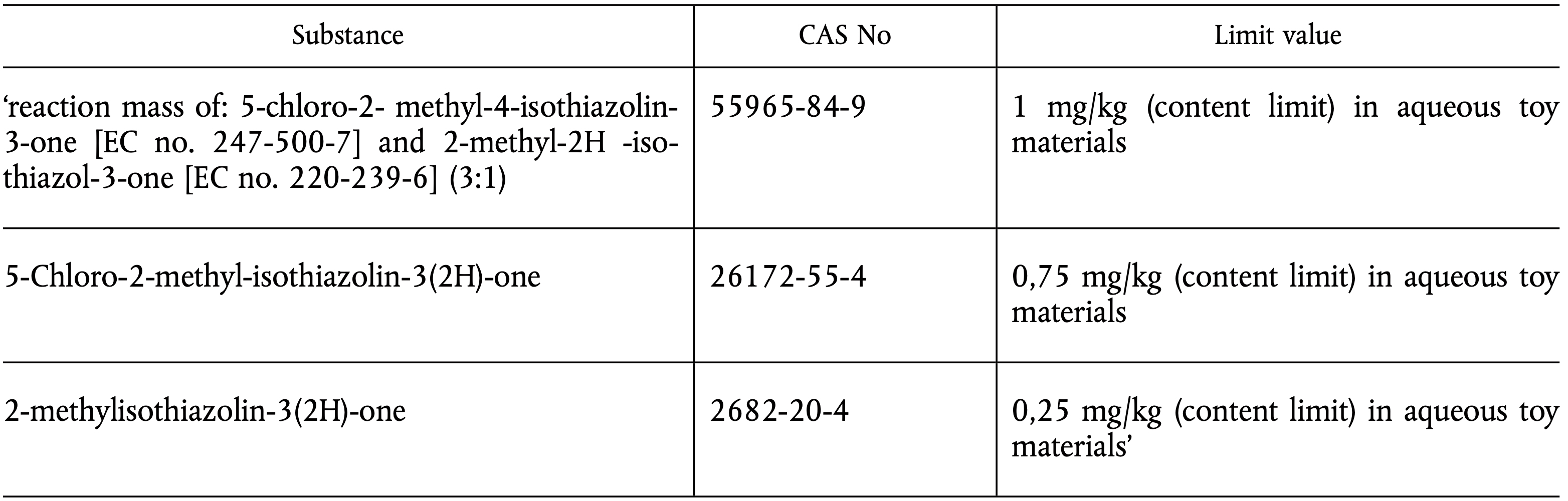
To be sure, producers of children’s toys should abide by the regulations. There is no debate on this. However, legal standards such as these are less about safety and more about regulating the market, and that is a good thing.
However, if products are found to contain too much of a ‘good thing’, what are the risks involved?
That is a different kind of question as to answer the following: should the products be recalled as to protect the public? What is clear is that regulators want to be on the safe side as if there are no societal costs involved other than keeping people safe!
We’ll talk about these costs at the end of this post, and it is not just about money!
The wonderful world of risk assessment (seriously briefly)
So, how does one assess the risks when exposed to products, such as toys, that contain above-legal levels of certain chemicals? Usually, what follows is a numbers-shuffle on who is on the ‘right side of safe’ (the regulators of course) and who ‘defends ‘unsafe’ children’s toys’.
The most straightforward numbers are the safety/uncertainty/assessment factors, a factor to derive a reference dose below which an adverse effect is unlikely to occur. Fair enough.
The adverse effect of choice, some toxicological endpoint - say the No-Observed Adverse Effect Level (NOAEL) such as the NESIL mentioned above - regarded as non-harmful, is divided by a 100 or 300 of whatever safety number is deemed appropriate to determine an acceptable exposure level (AEL).
These factors try to account for uncertainties in the data on which some NOAEL (or any other endpoint) is based: differences between animals and humans, variations among people, gaps in experimental studies.
Be that as it may, why not choose the highest safety factor possible anyway? A 1000; 10000? We can’t be safe enough, especially when children are involved, can we? Right?
Well, if we do thát, no synthetics - preservatives - can be added to children’s toys. Ever. In fact, nothing of the chemical kind must come into contact with anybody. That of course makes no sense whatsoever.
If we stick to preservatives, these should be subsequently banned from children’s toys. That results in letting children play with, eventually, mouldy clay, although that is certainly unacceptable.
Best then to ban all clay materials in the toy department? Seems the wisest of choices.
But, this is just the beginning of the risk assessment ‘game’. Exposure to the preservatives during playtime is another big thing. How to assess that?
Okay, we could measure how much clay sticks to the hands during a certain amount of playtime, weigh that and use that data to guesstimate preservatives-exposure. Surprisingly, that actually has been done, but there’s a catch.
The adhesion of the clay to the hands is a proxy (substitute) for the actual bioavailability of preservatives from the matrix to the clay-covered skin. It is assumed that the full mass of the preservatives as found in the clay attached to the hands is completely ‘in touch’ with the skin during playtime.
That, of course, is false and thus we find ourselves in the land of worst-case scenario’s, thé preferred institutional risk approach as we will see when PFAS is concerned.
PFAS - fear-mongering forever!
Before we turn to the dioxins of the 21st century - PFAS aka the ‘forever chemicals’ we all should fear forever - risk assessment is not a form of relativism where one can choose whatever one wants.
That is simply false.
What I am trying to point out is that choices in the risk assessment-arena nééd to be made and made with crystal clarity. Preferring worst-case (exposure) scenarios in risk assessments, for instance, is a choice with a certain ’logic’ that can be criticised, which I did recently.
Also, safety factors do have a certain logic that can be defended ánd critiqued.
That being said, we now move from toy clay to breast milk, as the latter has been found contaminated by PFAS. It’s all in RIVM-briefrapport 2026-0028. This is the report’s cue (bold added):
“PFAS is present everywhere in the environment. Previous studies by RIVM have revealed that almost everyone in the Netherlands has too much PFAS in their blood. RIVM has now investigated how much PFAS is present in breast milk. The study also assessed how often there is too much PFAS in breast milk (in other words: higher than the ‘risk limit’). …
Levels of PFAS exceeding the risk limit were found in 18% of breast milk in the study. At such levels, PFAS can have an impact on the body. In babies, if the exposure levels are too high, this can lead to the immune system functioning less effectively. This does not mean that these babies will immediately become ill as a consequence. The risk of illness depends on a number of circumstances, including heredity and living conditions.”
Apart from the exasperating tentative language that gives us no lead or direction ("… can have …", “… can lead …”), the first question needs to be: what units are we talking about?
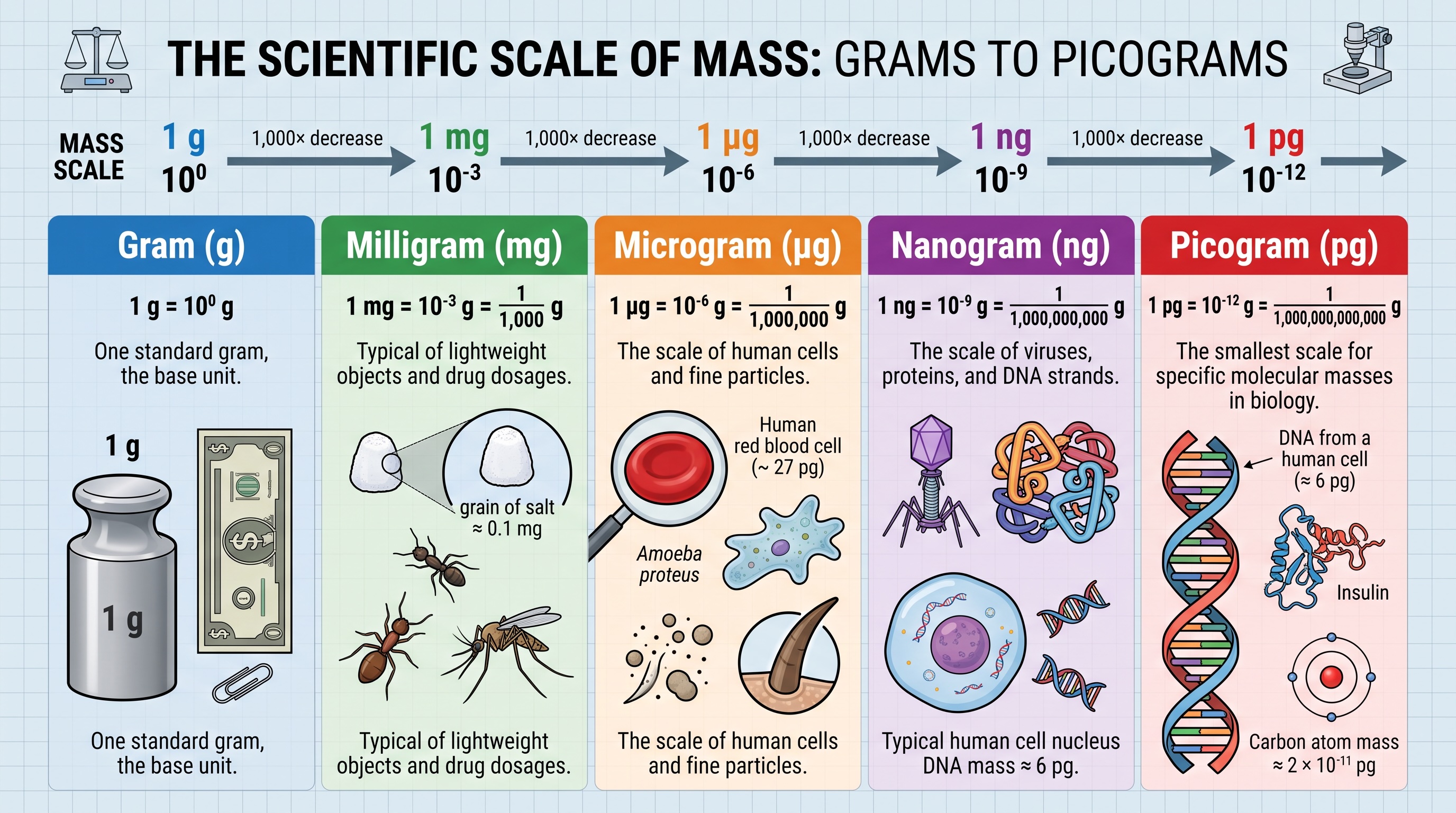
Answer: picograms per ml breastmilk. Let’s try to visualise what a picogram is - 0.000000000001 gram - compared to other units of mass starting at 1 gram. An attempt:
Second question: of the 29 different PFAS searched for in breastmilk, how many different types of PFAS were actually detected? The reassuring news is that 21 of the 29 PFAS were rarely if at all detected. Below is a sampling of the RIVM-finds:
Third question: what is the risk limit and what is the foundational research for that limit? The RIVM reports that the paper of choice on immunotoxicity (vaccine response) is from Abraham, et al. (2020). This, despite the fact that the individual data from this study are not available!
The EFSA reports a tolerable weekly intake (TWI for the so-called EFSA-4, which are PFOA, PFNA, PFHxS, PFOS) of 4.4 ng/kg bw per week based on effects on the immune system (immunotoxicity) as the most critical for the risk assessment
The RIVM used this TWI as a baseline for modelling a maximum of PFAS concentration in mother’s milk, which is reported to be 133 picogram/ml for a whole year of feeding (although almost al; babys don’t receive a whole year’s worth of only breastmilk!).
What I find quite surprising and scientifically wholly unacceptable is that no in-depth critical reflection on the paper of Abraham, et al. (2020) is presented by the RIVM, as they should have done. Read with me the critique we produced on this paper, to be found in our paper The PFAS Conundrum—Of Logic, Science, Policy:
“No data is presented in or with the paper; only model outputs are given. Again, no plots of serum PFAS levels and actual antibody levels, or the actual changes in antibody levels, are presented. A “significant” regression is insufficient, especially when the analysis uses a technique that is not reproducible (i.e., the stepwise approach, which is notorious for over-fitting). We are not told what went into the model. When considering real-world immunity issues—disease—the authors remark that “no associations were observed between levels of PFOA/PFOS measured at the age of 1 year (postnatal exposure) and the number of infections within the first year of life. This may be due to levels of PFASs being not high enough to cause this effect or due to a protective influence of the long duration of breastfeeding in the higher exposed children, if indeed an impact on the occurrence of infections is to be expected at higher levels of exposure”. Corroboration for this proposal is, however, not given.”
To use everyday vernacular: Abraham et al.’s paper is garbage. The RIVM gives us no indication that that is exactly the case. Neither does the EFSA. The RIVM could have at least taken notice of the paper we produced.
Oh, never mind. Our paper does not follow the standard narrative of ‘PFAS-bad’.
In conclusion
I promised you costs, and not just of the monetary kind. Here they are.
Recall the modelling clay. Yes, producers exceeded a legal limit, and rules are rules — markets need them. But a legal exceedance is not a health catastrophe; the standard regulates commerce more than it measures harm.
The alternative to preserved clay is, sooner rather than later, mouldy clay — and moulds, unlike MI/CMI at playtime levels, are demonstrably nasty: toxin-producers, allergen-factories. Ban the biocide and you trade a potential risk, conjured out of worst-case arithmetic, for a real one.
That is not safety; that is bookkeeping.
And breastmilk? Concentrations are counted in picograms per millilitre — a millionth of a millionth of a gram — with 21 of the 29 PFAS rarely if ever found, tested against a ‘risk limit’ that rests, to some extent, on a study whose underlying data nobody outside the authors has ever seen.
On thát shaky foundation, 18% of Dutch breastmilk is now branded ‘above the risk limit’.
What is a young mother to do with such a verdict? The one thing everybody in this field actually agrees on is that breastfeeding is good for babies. Every mother who is frightened of the picogram-arithmetic is a real, flesh-and-blood cost of a phantom precision.
So, let’s tally the bill. Products destroyed and shelves cleared over limits that protect the market rather than the child. Nursing mothers unsettled by numbers built, in part, on unpublished data and an unread critique.
Regulators thus train the public to detect ‘danger’ in starch, toys and mothers’ milk, while the capability to distinguish real risks (fungal toxins!) from homeopathic ones quietly withers.
And underneath it all is a growing distrust of chemistry, of industry, of institutions, and of one’s own body. It is precisely through everyday stuff that chemophobia becomes entrenched: not by disasters, but by clay and milk.
None of this is an argument against good risk assessment strategies. It is an argument for doing it in the open.
Choices must be made — endpoints, safety factors, exposure scenarios — and they must be made ánd defended with crystal clarity, not smuggled in as worst-case defaults and tentative ‘can have an impact’-prose.
The dose makes the poison; the source — natural or synthetic — does not. Until our institutions relearn to say so out loud, the moulds will remain more honest than the risk communiqués.
And that, dear readers, is the biggest cost of all: fear, not PFAS, is the real forever chemical.